
Di ba May Contract Naman? What Actually Happens to Your Wedding If There’s a Typhoon or Flood
Every typhoon season, the same posts start appearing on social media. Couples who pushed through their wedding kahit bagyo. Venues flooded. Suppliers who showed up, suppliers who didn’t. And somewhere in the middle of all that chaos, a bride or groom left wondering: wait, what does my contract actually say about this?
One of my readers sent me a question that I think a lot of you have quietly wondered about too. She asked it so clearly that I wanted to address it properly, not just in a quick caption.
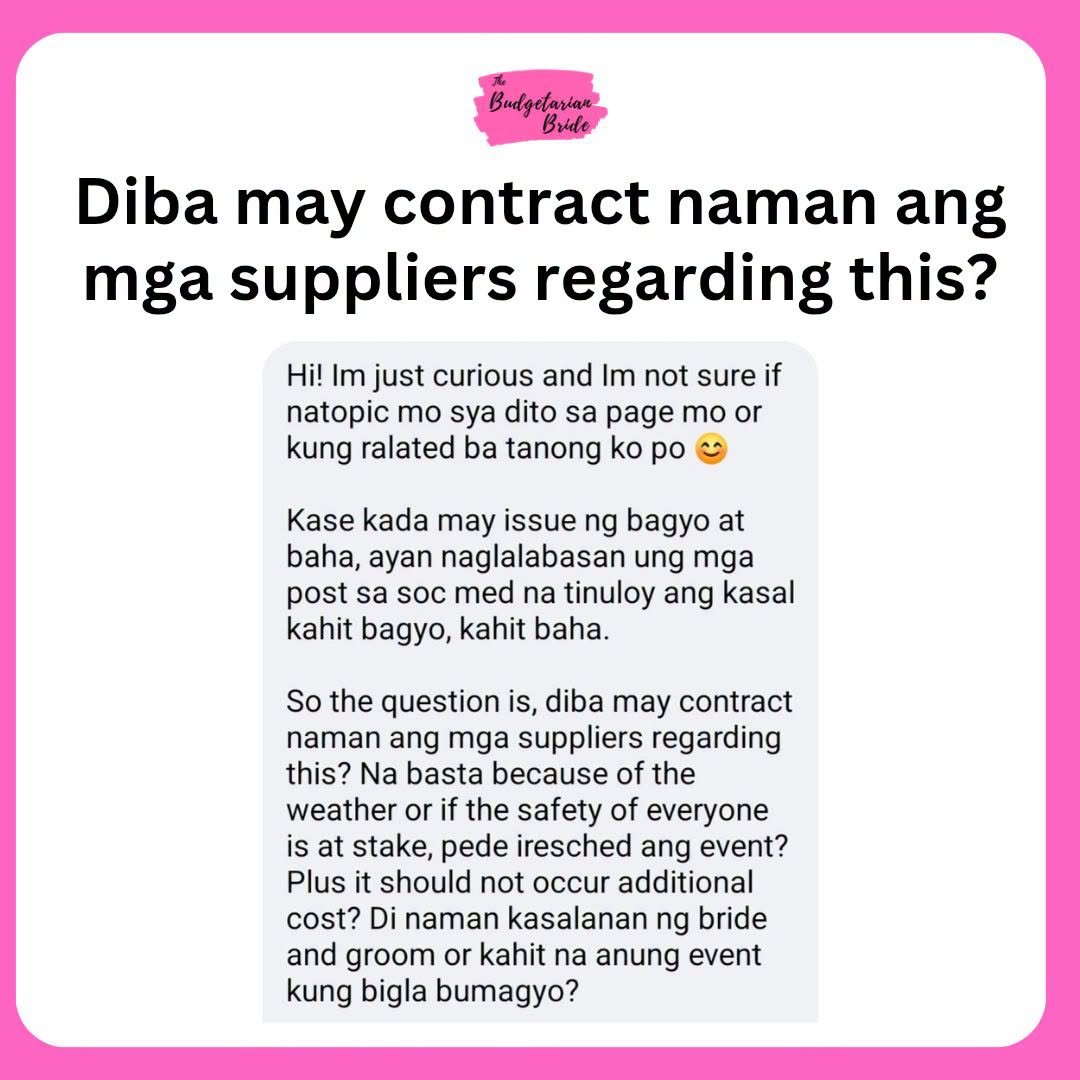
“Kase kada may issue ng bagyo at baha, ayan naglalabasan ung mga post sa soc med na tinuloy ang kasal kahit bagyo, kahit baha. So the question is, diba may contract naman ang mga suppliers regarding this? Na basta because of the weather or if the safety of everyone is at stake, pede iresched ang event? Plus it should not occur additional cost? Di naman kasalanan ng bride and groom or kahit na anung event kung bigla bumagyo?”
Valid na valid, sis. And the honest answer is: it depends entirely on what your contract says.
Hindi Automatic ang Libreng Reschedule
I know that feels unfair, kasi tama ka naman. It really is not your fault kung bumagyo. But supplier contracts in the Philippines are not standardized. Every supplier writes their own, and the terms vary a lot.
Some suppliers have a solid force majeure clause. This covers events completely outside anyone’s control, like a typhoon, a flood, a government-declared state of calamity, or an official order to stop travel or gatherings. Under a good force majeure clause, you can reschedule without penalty and your payments get credited to the new date.
But some contracts only have a general rescheduling policy, with a rescheduling fee regardless of the reason. And some, grabe, have no contract at all.
So before you assume your deposit is safe when disaster strikes, you need to actually read what you signed. Or what you haven’t signed yet, if you’re still in the booking stage. This is exactly why knowing what to check before you sign is one of the most important parts of supplier vetting.
What to Look for in Your Supplier Contract
You’re not looking for a legal degree here. You’re looking for these specific things, written clearly in plain language.
- What counts as an emergency or force majeure. Does the contract specifically mention typhoons, flooding, government advisories, or unsafe conditions? Or is it vague? Vague is not your friend.
- Whether rescheduling is allowed under those conditions. Some contracts say yes, some say it’s at the supplier’s discretion. You want it in writing, not just a verbal “sige naman.”
- Rescheduling fees, if any. A good supplier understands that a typhoon is not your fault. But you still need to know upfront kung may bayad or wala.
- Whether your deposit and payments roll over to the new date. This is the big one. Kung sinabi nila na credited siya, dapat nakasulat sa contract.
- What happens if the supplier is unavailable on your rescheduled date. Are you entitled to a refund? A partial refund? Nothing? Know this now, not on the day itself.
These are not demanding questions. These are reasonable things to understand before you hand over a downpayment. And if a supplier makes you feel unreasonable for asking, that tells you something important about them. You can read more about those kinds of patterns in my post on wedding supplier red flags in the Philippines.
What If It’s Not in the Contract?
Ask if you can have it added. Seriously. Before you sign, you have the most leverage you will ever have with a supplier. After you sign and pay, your options get smaller.
A simple line added to the contract can say something like: “In the event that a typhoon signal, government travel advisory, or declared state of calamity prevents the event from proceeding on the contracted date, the client may reschedule to a mutually agreed date at no additional charge, with all payments credited to the new date.”
That’s it. That’s all you need. Some suppliers will agree easily. Some won’t. And how a supplier responds to a fair request like this is itself useful information about whether they’re the right fit for you.
What About Suppliers Who Give No Contract At All?
This is a real situation, and it’s one of the biggest costs you didn’t see coming in wedding planning. When there’s no contract, there’s no protection. Not for you, and technically not for them either. But in practice, you’re the one who loses money and a wedding date.
No contract is a red flag. Full stop. It doesn’t matter how nice the supplier is, how many good reviews they have, or how excited you are about their work. If they won’t give you a written agreement, do not pay them.
A good supplier wants a contract too, kasi it protects both parties. If they’re avoiding it, ask yourself why.
A Note on Typhoon Season and Wedding Dates
The Philippine typhoon season runs roughly from June to November, with the peak usually between July and October. If your wedding date falls in this window, this conversation matters even more.
When you’re still in the early stages of locking down your date and venue, it’s worth factoring in the weather risks for that time of year. There’s a fuller breakdown of the decisions to make early in this post on how to start planning a wedding, including how your date affects almost every other decision that follows.
And even if your wedding is not during peak season, emergencies happen year-round. A contract with clear emergency provisions is never a waste. One of my brides had typhoon-level rain on her February 14 wedding in Manila
Your Wedding, Your Money, Your Responsibility to Read the Fine Print
Sis, I know contracts feel intimidating. Legal language, small print, pages you want to just scroll past so you can get to the fun part. But reading your supplier contracts is one of the most protective things you can do for yourself and your budget.
You cannot control the weather. You can control whether you fully understand what your contract says before disaster weather arrives.
“Di naman kasalanan ng bride and groom or kahit na anung event kung bigla bumagyo?”
She’s right. It’s not your fault. But knowing your rights under your own contract? That part is yours to own.
If you’re mid-planning and you realize you haven’t checked your contracts closely, start now. Pull them out, look for the clauses above, and if something is missing or unclear, message your supplier before your wedding date gets any closer.
And if you’re still in the early stages of planning and you want a clear framework for vetting suppliers, knowing what questions to ask, and making sure you don’t get caught off guard by contracts or costs, my free guide walks you through exactly what to do in your first month as a bride-to-be. Grab it at thebudgetarianbride.com/first-30-days and start planning from a place of information, not panic.
If you want to go even deeper into the whole supplier-booking and budget-planning process, the Wedding Planning for the Clueless Bride-to-Be eBook covers it step by step, from reading contracts to booking the right suppliers in the right order.
Save this post, sis. Check your contracts today. Especially if your wedding is anywhere near typhoon season. 🌧
Frequently Asked Questions
May force majeure ba talaga ang supplier contracts sa Pilipinas?
Some suppliers include a force majeure clause, some have a basic rescheduling policy, and some have no written contract at all. There is no required standard in the Philippines, so the protection you have depends entirely on what your specific contract says. Always read and ask before you sign.
Kailangan ko bang magbayad ng rescheduling fee if may bagyo?
It depends on your contract. If the contract has a clear force majeure or emergency provision that covers typhoons and unsafe conditions, rescheduling fees may be waived. If the contract only has a general rescheduling policy, the fee may still apply even for weather-related postponements. This is why checking your contract before signing matters so much.
Pwede ba akong humiling na dagdagan ang contract bago ko pirmahan?
Yes, and you should. Before you sign and pay, you have the most room to negotiate. Ask your supplier to add a clause that specifically covers typhoons, government advisories, or declared states of calamity, and that states whether rescheduling is penalty-free and whether your payments are credited to the new date. A professional supplier will take this request seriously.
What if walang contract ang supplier ko at all?
No contract means no written protection for either party, and in practice that usually hurts the couple more than the supplier. Treat the absence of a contract as a red flag and do not release any payment without one. Ask for a written agreement and if the supplier refuses, consider whether they are the right fit for your wedding.
Kailan dapat i-check ang supplier contracts para sa typhoon provisions?
Before you sign, ideally. But if you have already signed, check them now, especially if your wedding falls between June and November. If you find that a provision is missing, contact your supplier in writing and ask if it can be added. The earlier you raise this, the easier it is to address.
Pano kung sinabi lang ng supplier na “okay lang, pag may bagyo re-reschedule tayo” pero wala sa contract?
Verbal assurances are not enforceable. What matters legally, and practically, is what is written in the contract you both signed. Ask the supplier to put that assurance in writing as an addendum to your contract before you proceed with payments. If they are not willing to write it down, that tells you a lot.